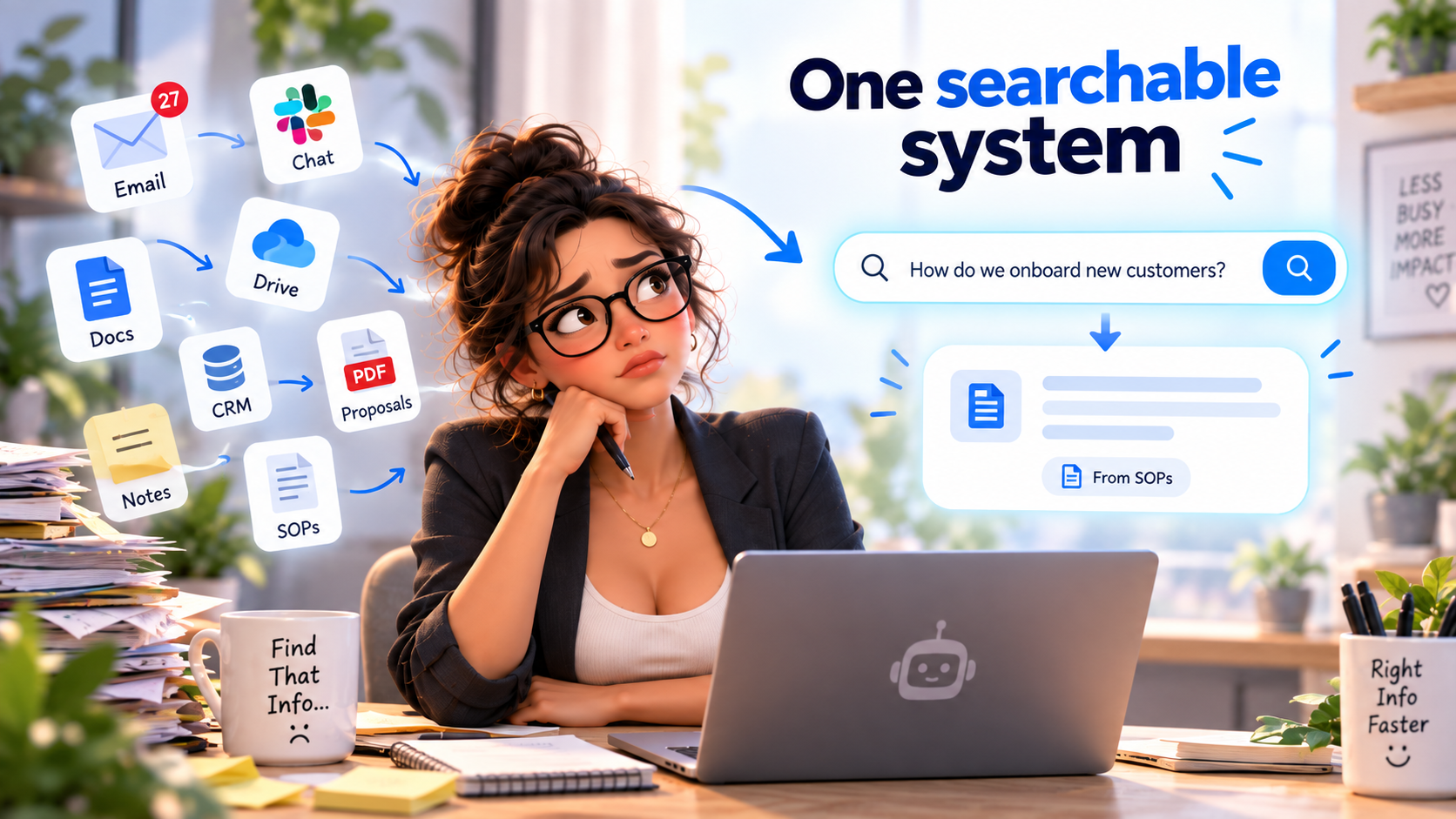
As companies grow, knowledge starts spreading everywhere.
Important information lives in:
- emails
- Google Drive or SharePoint
- Slack or Teams
- CRM notes
- SOPs
- project tools
- old proposals and documents
- sometimes just inside someone's head
The problem is usually not that the information does not exist. It is that nobody knows where to find it quickly.
In this article
- Why company knowledge becomes difficult to access
- How AI can search across different systems
- What employees could actually ask it
- What needs to be controlled before rollout
1. The problem is not storage. It is retrieval.
Most businesses already store plenty of information.
But finding the right answer may mean:
- searching old emails
- opening several folders
- asking someone who worked on the project
- checking CRM notes
- scrolling through months of chat history
Imagine a salesperson asks: “What pricing did we offer this customer last year?”
Or someone in operations asks: “What was our process when this issue happened previously?”
The answer probably exists. Finding it is the expensive part. 🔎
2. AI can become a search layer across company knowledge
Instead of moving everything into one giant database, AI can sit across the systems the company already uses.
For example:
- internal documents
- emails
- CRM
- support history
- project documentation
- internal chat
- company policies
An employee could then ask:
“What did we promise Client X regarding support?”
Or:
“Show me our process for handling overdue enterprise customers.”
The AI searches the relevant sources and returns the most useful answer. Ideally, it should also show where that answer came from so the employee can verify it.
That is much more useful than simply creating another folder called “Knowledge Base.” 🧠

3. The biggest value is reducing repeated questions
Every company has questions that keep coming back.
Examples:
- “Where is that document?”
- “Who handled this customer before?”
- “What did we charge last time?”
- “What is our policy for this?”
- “Has anyone solved this problem previously?”
Today, those questions usually interrupt another employee. A searchable AI knowledge system can answer many of them instantly.
A simple example
Suppose 20 employees each spend just:
| Scope | Time spent finding information |
|---|---|
| Each employee | 10 minutes per day finding information |
| That becomes: | 200 minutes per day |
| or roughly: | 73 hours every month |
Even reducing that by half gives the team back a meaningful amount of time. ⏱️
4. Access control matters as much as AI
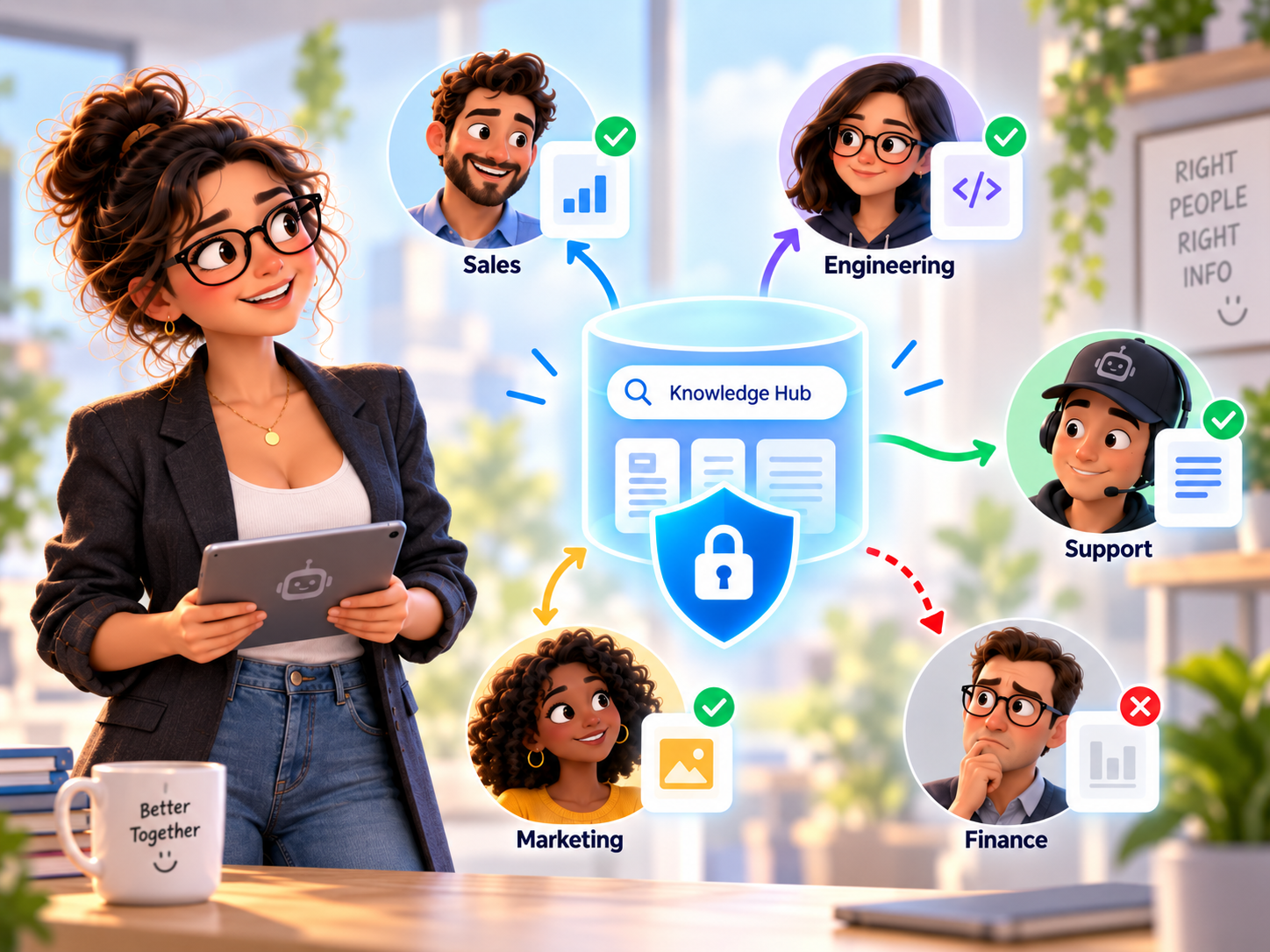
Centralised search does not mean everyone should see everything. Finance records, HR information, customer contracts and management discussions may all require different permissions.
A useful system should respect the access employees already have.
For example:
- sales can search sales information
- support can access support history
- finance data remains restricted
- management documents stay private
The AI should also say “I don't know” when reliable information is not available instead of inventing an answer.
A confident wrong answer can be worse than having no answer at all. ⚠️
The goal is not to centralise every file
Companies often think they need to reorganise years of documents before using AI. Not necessarily.
The better goal is: Make existing company knowledge easier to discover and use.
Your information can continue living in different systems. AI can become the layer that helps people find the right piece of knowledge when they actually need it.
Over time, that can turn scattered information into something much more valuable: shared organisational memory.
How Hupp can help
Hupp can help you identify where your company knowledge currently lives, decide what should be connected first, and plan the right AI search approach around your existing tools.
You do not need to change everything at once. We can help you design a step-by-step implementation, starting with one team or knowledge source and expanding only after it proves useful.