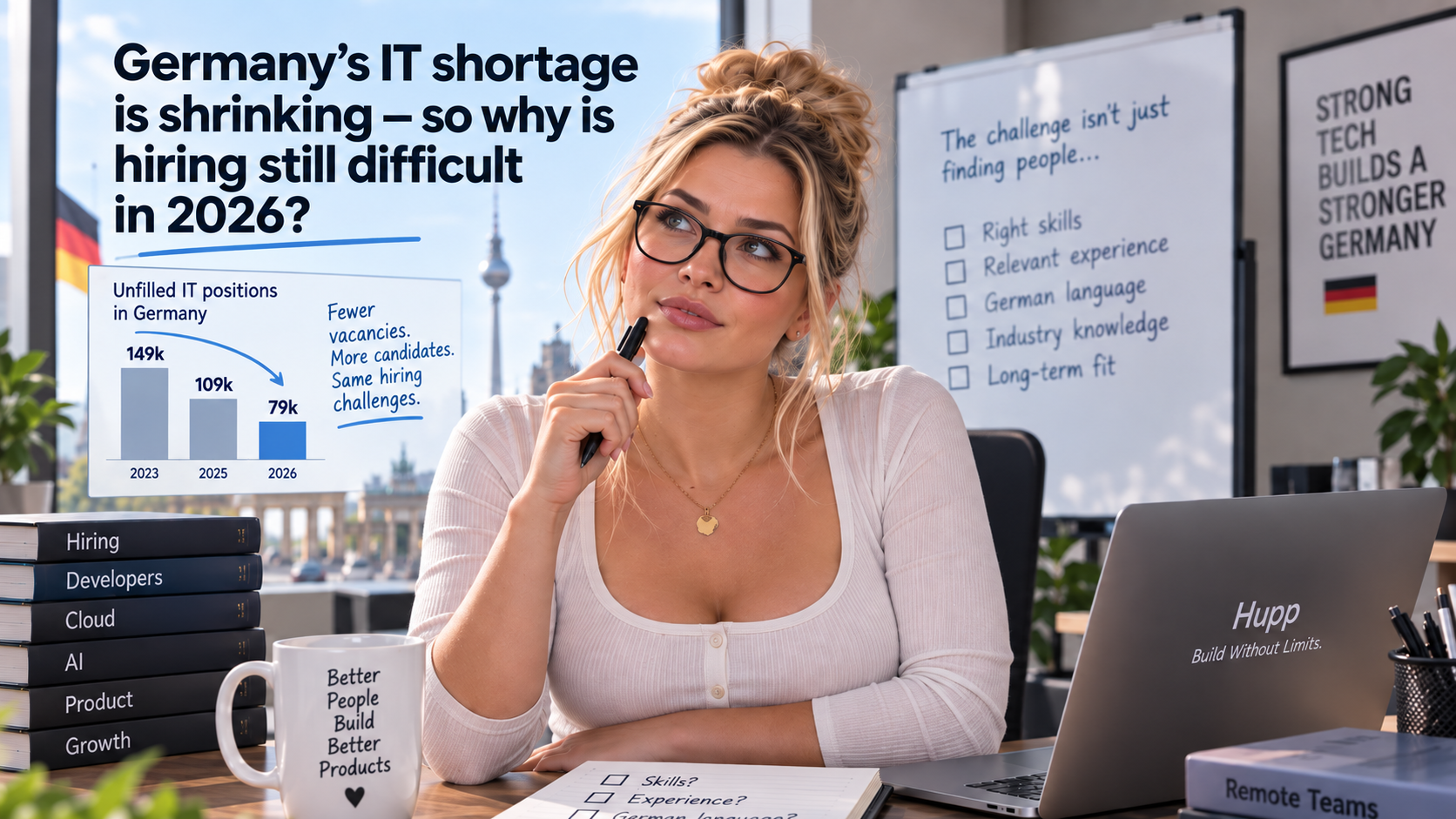
Germany's IT talent shortage looks much healthier than it did a few years ago.
Bitkom estimates that the country has around 79,000 unfilled IT positions in 2026, compared with 109,000 in 2025 and 149,000 in 2023.
That sounds like a major improvement.
But then there is another number: 97% of German companies currently recruiting for IT roles say they are still having difficulty filling them.
So the shortage has almost halved, yet hiring remains difficult.
The reason is fairly simple: Germany does not just have a shortage problem anymore. It has a matching problem.
Why the shortage fell
Part of the reduction has happened because companies are simply hiring less.
Germany's Federal Employment Agency recorded around 13,000 ICT vacancies in 2025, 22% fewer than the previous year. It also reported that fewer new ICT projects had been launched inside companies since 2024.
At the same time, ICT unemployment increased from 3.7% to 4.5%.
So a drop from 149,000 unfilled IT positions to 79,000 does not mean Germany suddenly found another 70,000 developers.
Some positions disappeared because businesses slowed hiring.
The Federal Employment Agency also found that the software-development shortage that had appeared repeatedly in previous shortage analyses was no longer visible in 2025, although shortages remained in some specialist IT occupations.
The overall market has cooled. That has not solved the next problem.
Finding the right person
When companies were asked why they still struggle to fill IT roles, the answers were quite specific:
That explains why more available candidates do not automatically make hiring easy.
A company rarely needs just "a developer".
It may need someone who already understands its particular backend stack, cloud setup, databases, security requirements and third-party integrations.
For another business, the requirement might be React, Node.js and AWS today — then AI integration or data engineering six months from now.
There may be developers looking for work. Finding the right combination of experience is still the difficult part.

Skills are moving quickly
AI is adding another layer to this.
Writing routine code is becoming faster. Coding assistants can already handle a meaningful amount of repetitive development work.
But companies still need people who can make decisions around architecture, security, scalability, production failures and complicated integrations.
The Federal Employment Agency says digitalisation, automation and AI are actually raising the skill requirements for ICT roles, even while Germany's weaker economy is slowing overall recruitment.
The hiring numbers show the same pattern.
More than 40% of the 39,000 newly registered ICT jobs were aimed at expert-level workers, while around one third were aimed at specialists. Unemployment among highly qualified ICT experts remained only 3.5%.
So Germany can simultaneously have: more IT professionals looking for work and companies struggling to find experienced engineers.
There is no contradiction there. The available skills and the required skills do not always match.
Software skills are still needed
Software development itself has not disappeared from the hiring market.
The same study puts the largest demand currently in IT administration and systems operation at 26%, followed by software development and architecture at 17%, with cloud and infrastructure at 14%.
The difficulty for many companies is that modern products increasingly cross several of these categories.
A SaaS product may need:
- frontend and backend development
- cloud infrastructure
- database work
- security
- integrations
- AI capabilities
One employee rarely has deep experience in all of them.
A larger company can build a team around those skills. For a smaller company, hiring several specialists may simply not make financial sense.
What this means in 2026
Germany's IT hiring situation has improved, but mostly in terms of volume.
There are fewer vacancies. More candidates are available. The extreme shortage seen a few years ago has eased.
What has not disappeared is the difficulty of finding people with the exact skills companies need.
That changes the hiring question.
Instead of only asking:
"Can we find a developer?"
companies increasingly need to ask:
"Can we find the right engineer for what our product needs now?"
And sometimes the answer may change again six months later.
That is why permanent hiring still makes sense for stable, long-term roles — but it is not the only way to build development capacity.
Need engineers sooner?
Hupp provides on-demand software engineers on a weekly or monthly basis.
You can add the skills you need without waiting through a long recruitment process or immediately committing to another permanent hire.
Simple as that.